Napoleon Bonaparte famously stated that England was “a nation of shop keepers”. People went into the trade for many reasons and catered to many different social classes. On the 1881 census for Wrexham in North Wales, Sarah Astle of 5 Park Street, is listed as a Grocer/Provision Dealer. What has led Sarah to enter into this male dominated profession? To find out the possible answer we must visit Wrexham Cemetery.
Wrexham Cemetery is a Victorian garden cemetery which opened in 1876. The site is approximately 7 hectares in size and 39,000 burials have taken place there leading to it now having limited space left for new burials. The original cemetery was divided between Anglicans, non-conformists and Roman Catholics.
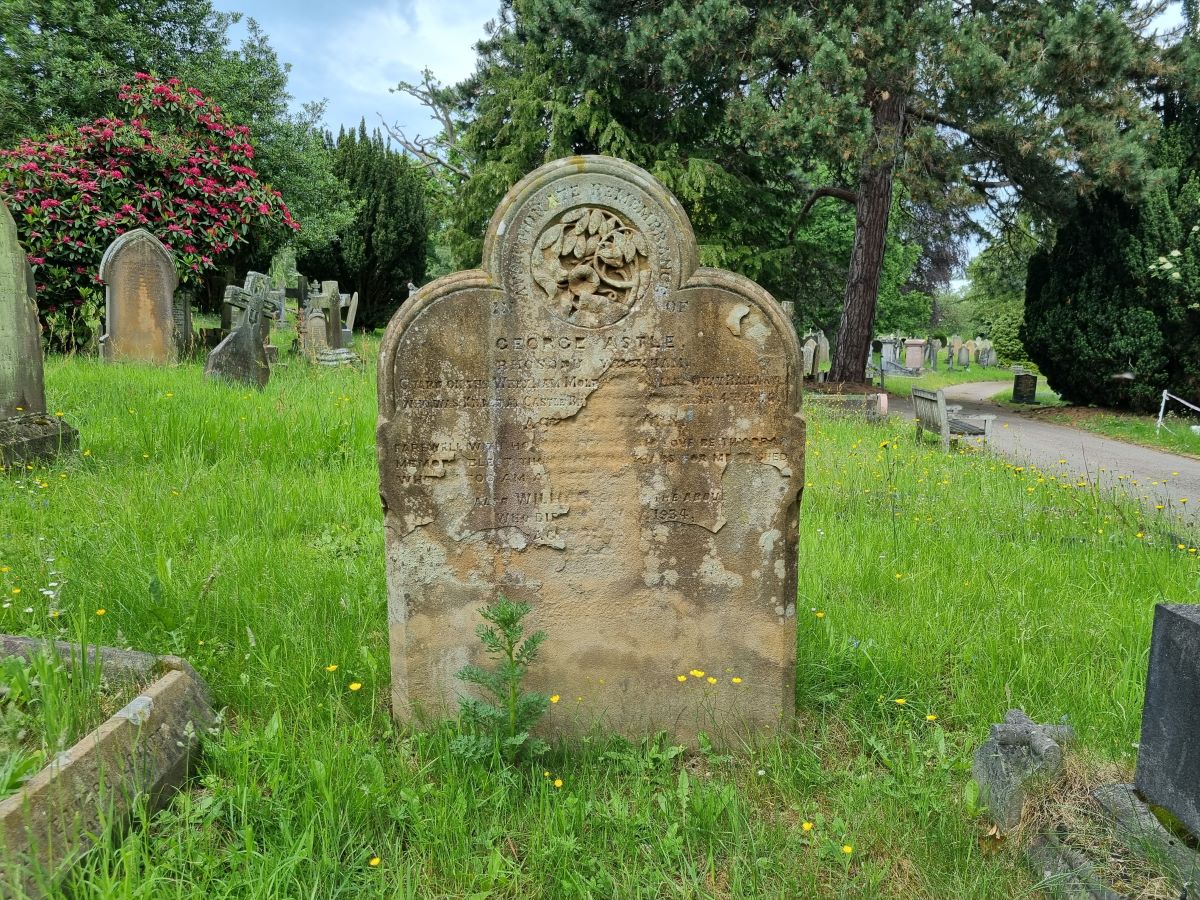
The grave that we are interested in relates to a tragic railway incident which happened in the year that the cemetery was opened. The gravestone is now hard to read as it has been damaged by the passage of time and weather.
What can still be deciphered says,
In Affectionate Remembrance Of George Astle, Rhosddu, Wrexham.
Guard On The Wrexham, Mold & Connahs Quay Railway Who Was Killed At Castle Brick December 4th, 1876,
Aged 37 Years.
Also William, Son Of The Above, Who Died May 7, 1934, Aged 71 Years.
Who was George Astle and what had happened to him?
George Astle was 37 years of age and had worked for the Wrexham, Mold and Connah’s Quay Railway Company for about 12 years. He was married to Sarah and they had four children. They lived in Park Street, Rhosddu in Wrexham.
On the evening of the 4th December 1876, he had been a guard on a goods train from Connah’s Quay which had been travelling towards the Castle Brick Works at Northop Hall. According to some reports of the accident, he was the brakeman on the locomotive. At the point where the railway line crossed the turnpike road was a level crossing with gates which had been left across the railway line. The train was travelling with the wagons in front and George Astle was riding on one of the wagons. At the level crossing the wagons had smashed into the gates and the wagon he was riding on had derailed causing George Astle to be thrown underneath and killed. It appeared that he had unsuccessfully attempted to scramble out of the wagon at the moment of impact. His body was taken to the Black Lion Inn at Northop Hall to await an inquest which commenced on the 9th December 1876.
The Black Lion Inn where the inquest was held (intriguingly known locally as the Bottom Monkey while another local pub was known as the Top Monkey) has since closed and is now a private residence.

At the inquest it transpired that the gatekeeper of the crossing had not been at his post at the time of the accident as he had thought that the last train had passed for that night. The inquest censured the management of the railway for the running of the line and noted that there had not always been danger signals at the crossing. The findings of the inquest were that of “Accidental Death” owing to general great negligence on the part of the management and the persons in charge of working the line and conducting the traffic.

Buckley was a major brick and tile making area with a long history. The Castle Brick Company had opened in 1866, becoming the Castle Firebrick and Coal Co in 1875 and part of John Summers Ltd of Shotton steelworks in 1916, as they used the Castle Firebricks in their furnaces. It passed to the British Steel Corporation in 1971. It was finally sold to the Butterley Brick Co in 1972 but finally closed in 1976.
Their clay pits were served by a narrow-gauge railway and a fleet of small steam locomotives. The railway line on which the accident happened is no longer there and the Castle Brick Works has gone. The A55 Expressway now runs alongside the site where it once stood. The Castle Brick Quarry can still clearly be seen on satellite imagery of the area and Castle Bricks can still be seen in many buildings in the area. You can also find them in the shrubbery, as I did when I found a pile of them near my house.

This incident left his wife Sarah a widow with a young family to provide for. Although the inquest had declared that the accident was owing to, “general great negligence on the part of the management”, it is unclear, but highly unlikely, that Sarah received any compensation for her husband’s death.
“There was profit to be made in grocery whichever level of society you served”
Annie Gray, The Bookshop, The Draper, The Candlestick Maker (2024: Profile Books Ltd, London)
The 1881 census shows Sarah Astle continued living at number 5 Park Street, Rhosddu, Wrexham with three of her children and two lodgers. She is listed as head of household and as a grocer and provision dealer. She has set herself up in business to sell provisions to her local community.

In a grocery serving the middle classes, Annie Gray notes that “you’d expect to be offered a seat. Service was efficient and highly personal, and assistants were almost always men.” and so, it may have been somewhat unusual for a grocer and provision dealer to be a woman. However, I have found another instance in the census of 1911 in Wanstrow in Somerset, where Isabella Cox ran a grocery seemingly from her cottage. She was also widowed and so perhaps it was a viable way to provide for their families on their own terms.

It may have been a good business idea too, as the area of Rhosddu had been expanding over the previous years and had become a “populous suburb” (Alfred Neobard Palmer The history of the town of Wrexham its houses, streets, fields and old families 1893: Woodall, Minshall, and Thomas, Wrexham)
I wonder what Sarah’s Grocery looked like and what it sold. I have not been able to find any old photos so far. Number 5 Park Street has since been redeveloped and new houses appear to have been built where it once stood. Much of the rest of the old Park Street remains.
On the 1891 census Sarah Astle is listed as Sarah Lloyd, presumably the wife of her former lodger Llewellyn Lloyd who is a book keeper (a safer profession I would imagine than railway guard). They still live in the Rhosddu area of Wrexham but have moved to Salop Terrace and have a daughter. One of Sarah’s sons continues to live with them. Sarah has clearly decided that being a grocer and provision dealer is no longer her packet of tea.
By 1921 Sarah is widowed again and is listed on the 1921 census with her son Charles H. Astle still living with her. Sarah dies in 1925 aged 83 and was buried on the 9th April in the Wrexham Cemetery alongside her second husband Llewelyn Lloyd. I was unable to find the grave of Sarah and Llewelyn Lloyd at Wrexham Cemetery. Although, the really helpful gentleman in the office looked up the details and gave me a map, I couldn’t find a gravestone. Some gravestones are now very difficult to read due to the effects of weathering. The area where she was buried was not very far from where George Astle had been laid to rest.

Further reading and source material:
Annie Gray, The Bookshop, The Draper, The Candlestick Maker (2024: Profile Books Ltd, London)
Alfred Neobard Palmer The history of the town of Wrexham its houses, streets, fields and old families (1893: Woodall, Minshall, and Thomas, Wrexham)
https://en.wikipedia.org/wiki/Wrexham_Cemetery
https://wrexhamcemeterystories.com/story/789
https://www.findagrave.com/memorial/133964528/george-astle
https://wrexhamcemeterystories.com
http://comma.gtsystems.net/Media/014r0afh00jd.jpg

http://comma.gtsystems.net/Media/014r0afh00jc.jpg


Cheshire Observer 9th December 1876
Cheshire Courant 13th December 1876
Liverpool Daily Post 21st December 1876
Manchester Evening News 21st December 1876
Leave a Reply