Brighton is a lively and vibrant city on the South coast of England. It is famous for The Royal Pavilion, Pier and more recently the i360. It has a raffish and Bohemian air and has always been a place for amusement and decadence. However, like any other town with a history it has a darker side too.
The Preston Village area is now a part of the wider city located close to the busy London Road, which is the main thoroughfare from London. Once though it was a village, separate from its busy and noisy neighbour, and even today it retains a certain feeling of calm and a more village atmosphere. It has a leafy park, a manor house and a church dating back to the 13th century.
The pretty church of St Peter’s is now managed by the Churches Conservation Trust. It dates back to the 13th century although it has been refurbished and rebuilt a number of times since then. It still retains a feeling of a village church with a peaceful graveyard, the graves partly taken over by nature but many still legible and maintained. It is a pretty and convenient shortcut for locals heading into the adjacent Preston Park to walk their dog or attend their Tai Chi Class.

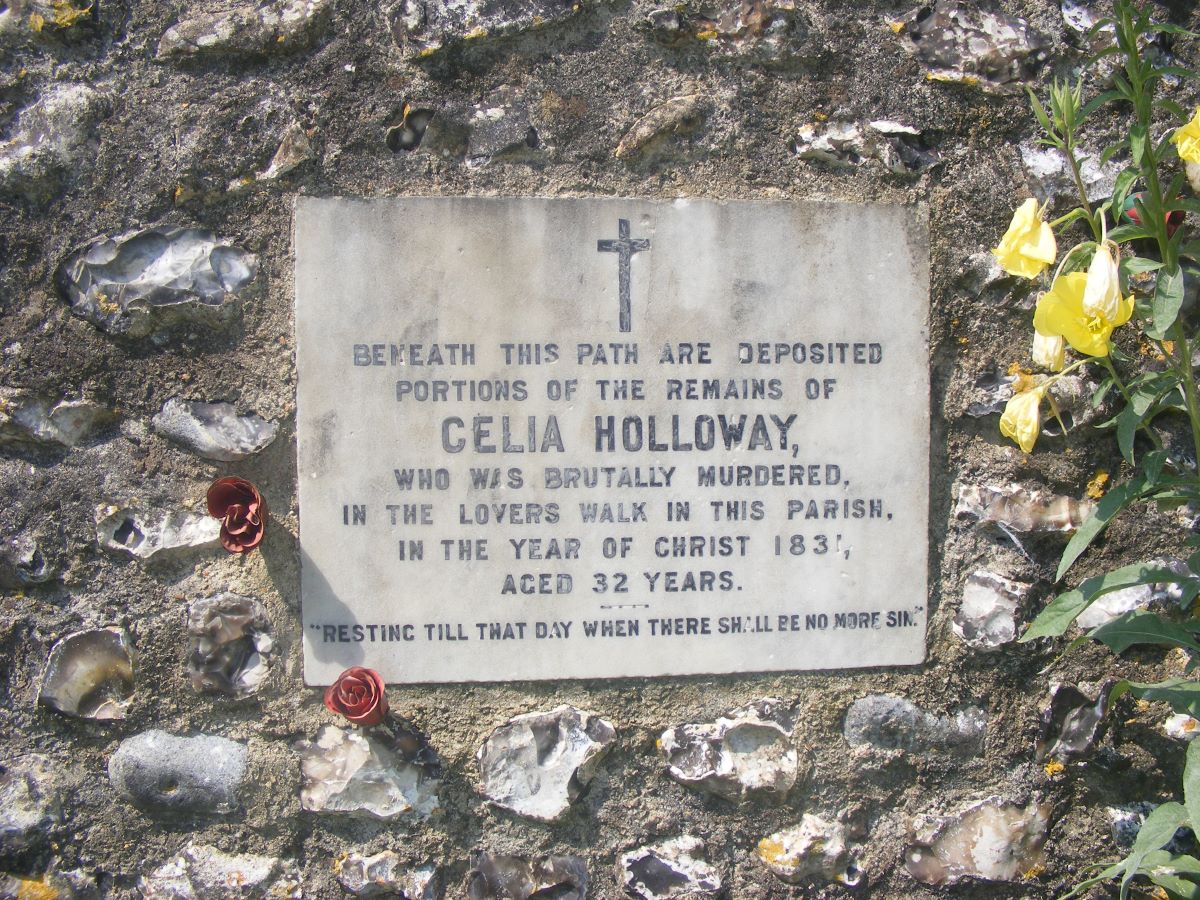
As you wander off the main pathway to explore the graveyard further you may notice a plaque set into the flint knapped wall. The plaque is a memorial to Celia Holloway and it reads,
Beneath this path are deposited
Portions of the remains of
Celia Holloway
Who was brutally murdered
In the Lovers Walk in this parish
In the year of Christ 1831
Aged 32 years
‘Resting till that day when there shall be no more sin’
Who was Celia Holloway and what led to her partial remains being buried beneath a pathway in this graveyard? The plaque states that she was brutally murdered in Lover’s Walk but this, it transpires, is incorrect. What did befall her? Was she brutally murdered and at whose hands? To discover her story, we must go back to 1831 and Brighton’s first trunk murderer, John Holloway.
John Holloway was a ‘practised seducer’ and bigamist who was something of a ladies’ man with plenty of charm but who was lacking in reliability. He was also violent with an ill temper. He had met Celia Bashford at Brighton Races and although she was 11 years older than him and he said he did not love her, he continued to see her and she fell pregnant. Unwilling to marry her, it took a spell in Lewes Prison and the encouragement of the Overseers of the Poor Law at Ardingly to persuade him to finally take her as his wife. They were married in Ardingly Church on the 12th November 1826.
The marriage was not a happy one and the child was sadly stillborn. There were other women and John frequently mistreated her. Eventually they split up and Celia returned to Ardingly with her brother. However, Celia later returned to Brighton where John joined her. The marriage did not improve and sometime later, when he was serving in the Coastal Blockade Service at Rye, John met Ann Kennett. In March 1830 he bigamously married a pregnant Ann under the name of John Goldsmith.
Upon his discharge from the Coastal Blockade, John and Ann returned to Brighton where a destitute Celia made application to the Overseers of the Poor for maintenance, which she was awarded. John often failed to pay and they frequently argued. At some point John must have decided to rid himself of Celia forever.
Somehow John Holloway persuaded Celia to go with him to a house he had rented in Donkey Row, a poor part of Brighton, to start a new life. There on the 14th July 1831, John and a willing or unwilling Ann, would strangle and dismember Celia who was now 8 months pregnant.
They placed some of her body in a wooden trunk which they wheeled out of Brighton and towards Lover’s Walk on the edge of Preston Village where they would attempt to bury it. The rest of her body was dumped in a privy.

At first they got away with it. They told anyone who enquired after Celia that she had found work in London. People may have been suspicious but they would become more than suspicious when the shallow grave was found in August and the authorities alerted.
Inquiries were made and John Holloway and Ann Kennett were arrested. At an inquest on the 14th August 1831 at The Crown and Anchor pub in Preston Village, a verdict of wilful murder against John Holloway was returned.

Eventually John Holloway confessed and gave a full account of the crime whilst making sure that he implicated Ann Kennett and blamed Celia and her family for his actions because of the way they had behaved towards him.
On the 15th December 1831, John Holloway was charged with murder and Ann Kennett was charged as an accessory of aiding, abetting, comforting and assisting him. The trial lasted one day. John Holloway was found guilty. Ann Kennett was found not guilty of murder but was charged with being an accessory after the fact.
On the 21st December John Holloway was hanged. Ironically considering the way he had disposed of poor Celia, his body was sent for dissection. Ann Kennett was later discharged of the charges brought against her and seemingly disappeared. But did she?
So, what of the plaque in the wall? It would seem that some of her remains were brought here and buried in the graveyard by Coroner’s Warrant not so far from the shallow grave they were once consigned to. The plaque may have been added later as some of the facts are incorrectly described. It serves to remind us of poor Celia and her fate at the hands of her faithless and abusive husband.

There is a further mystery, for many years after her murder, a flower would be found placed by the grave of Celia Holloway. No one seemed to know who left it but even into the 1990s, when I lived in the area, the flower would be placed.
These days a plastic flower marks the spot and wildflowers grow alongside Celia’s plaque in the wall to replace the flowers left by the mysterious visitor of years gone by.
Thank you for joining me in Brighton.
Join me again on 5th March for World Book Day when we meet a remarkable woman in a Brighton graveyard.
Join me on 10th March for an extra blog for the Modern Cockney Festival’s Pie ‘n’ Mash week.
Join me on 31st March to celebrate Women’s History Month – and a trip to some Wrexham Cemeteries.
Pubs which featured in the case:
The Crown and Anchor, Preston Road, Brighton
https://www.facebook.com/CrownAndAnchorBrighton/
The Hare and Hounds, London Road, Brighton
http://www.thehareandhounds.pub/
Further reading and sources:
Brighton Gazette, 18 August 1831 – details of the Coroner’s Inquest
Bell’s Weekly Messenger, 5 September 1831 – Commitment of Kennard (Ann Kennett)
Chester Chronicle, 26 August 1831 – Confession of the Murderer
Chester Courant, 3 April 1832 – Acquittal of Ann Kennett
Lancaster Herald, 24 December 1831 – Trial of John Holloway
Johnson, W. H., Brighton’s First Trunk Murderer 1831 (Downsway Books, 1995)
Holloway, John, ‘An Authentic and Faithful History of the Atrocious Murder of Celia Holloway: with an Accurate Account of All the Mysterious and Extraordinary Circumstances… (published by his own Desire for the Benefit of Young People 1832)
https://www.mybrightonandhove.org.uk/topics/topiccrime/trunk-murders/trunk-murders
https://www.mybrightonandhove.org.uk/topics/topiccrime/trunk-murders/preston_circus
Leave a Reply